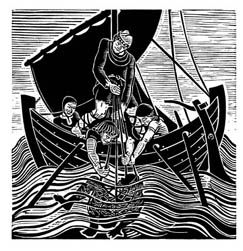
The wild man is lively in the medieval imagination. At a time when civilization is being constructed, the wild man, a human returned to nature and cut off from the civilised world, is something to reflect upon – shows medieval (literate? Created by literate strata but shared in wider popular culture) society. The tale comes from a monk, and in writings of the time there are lots of ideas of ‘other’ human forms mostly fairies, pixies, sprites, and the ‘wild man’ takes a smaller place in this panoply.
The story as told by the monk has been retold as two versions, one more brutal than the other. But original version:
A group of fishermen trawling the waters off the Suffolk coast by Orford find their nets to be heavy and hauling in their nets they discover a strange creature writhing amongst the fish. It is a man, covered in hair, naked, with a long shaggy beard. The fishermen take their catch into port, and lead their prisoner to Orford Castle. Here the governor attempts to speak with the wild man, but he cannot. The man grunts but produces no words. He kept in the keep and fed. He shows a preference for raw fish and will squeeze the dead fish to wring out their moisture and drink this from his hands before he eats the fish. He is taken to a church service at Orford Church but the sacraments mean nothing to him.
At this point there are differences in the telling. In one version the governor / people grow frustrated with the wild man’s refusal or inability to speak. He is hung upside down and flogged but it makes no difference.
In both versions, the man is taken back to the sea’s edge and is allowed to swim (it’s unclear why). In the more cruel version the people form a kind of cage around him with their nets so he cannot swim much out to sea. He slips the nets, swims out into the estuary jumping above the waves, and then slips below and is never seen again. In the other version he is not kept in chains in the castle, and he swims freely and comes back to land, and does this again and again over several months but becomes restless. One day he just swims off and is never seen again.
—————
What is he? Is he a barbarian, or man returned to a more natural state (pure)? Is he free of society and its shackles? Is he even human?
Orford Ness
Formed (forming) as a spit that meets the land at Aldburgh via a very narrow strip. River Alde runs where? 1910s thorough Cold War, military experiments. Parachutes, aerial photography, dropping weapons above enemy lines (one story of an inventor with parachute technology early on having his ideas rejected because the top brass thought it would encourage airmen to bail when afraid, rather like seamen often not learning to swim because of similar worries. They needed to rely completely on maintaining their ship. Funny idea with flight because surely knowing you can bail out might oppositely make a pilot more confident of taking risks knowing that if the plane is damaged he may still survive). Radar, radio navigation (1920s/30s – beacon). Explosives/nuclear weapons tech testing. Now a nature reserve with rare species, but limited access due in part to dangers left by its former use. Mimics Wild Man in dialogue here between science and nature; progress/civilisation and the undeveloped/natural state. During active periods of military research the locals were kept in the dark about what was going on, so rumours would emerge with several reports of ‘flying saucers’, and rumours of an invisible ray device being used that would shut down car engines.
Smugglers were common in the area in the 1800s.
In 1749 The Gentleman’s Magazine carried a story concerning several fishermen who were attacked by a winged crocodile-like creature which they snagged in their nets while off the coast in this area. The beast killed one man and disabled another before being slain. The ‘sea-dragon’ as it came to be known, measured just over a metre in length (though was said to be larger when alive), and possessed two legs with cloven feet. A fisherman travelled the county of Suffolk displaying the creature, though what became of the oddity is unknown. Charlatans!
What would the story be if the Wild Man had surfaced in 1939? What about during the Cold War? What about mid-19th century when industrial change is taking off at scale and people are leaving the land for the cities in large numbers? What would happen if it were tomorrow?
Why is it a curious tale?
Because the man cannot speak and is captured accidentally, and is ‘of the sea’. He is kind of pathetic, helpless, childlike. The stories suggest the village cannot decide if he is a threat or a novelty, a human or a pet. He is half man and half animal, half adult and half child. He is an inbetween creature, a bit like the ness itself, neither of the mainland nor of the sea. Also there is no resolution – he comes and then goes, without speaking.
The setting is striking too. It is edge of the (anglo-saxon) world. The nowhereland of the ness is a strange landscape. Its gradually, constantly shifting shape seems to speak of forces beyond humans that work at a different pace, slow and relentless change just below the surface of the water.
PREMISE
Tale of transformation. Foreign body is pulled from the sea into a small community. Unsure if he is a friend or foe he is held captive. Over time he forms a relationship with his jailer(s). He has something/does/knows something that has potential to transform the jailer/community/further afield. Eventually the transformation takes place and the wild man disappears back into the sea.
What is the transformation?
What state is the community in before he appears? What relationships exist (between people, and people and the land/sea, and wider world)? What has been happening before he appears?f
What role does superstition and ideas of magic play in the story?
Is he exploited?
What does he want to happen? Maybe he wants nothing to happen and just longs for the sea, and the things that change are not caused by him, but just by his unsettling presence.
Leave a Reply